

Our method
Here’s exactly what we do at every visit, and why. Nothing gets skipped, and everything gets written down.
What happens on service day
Eight stops, in the same order every week. Watch a visit, or pick any step.
-
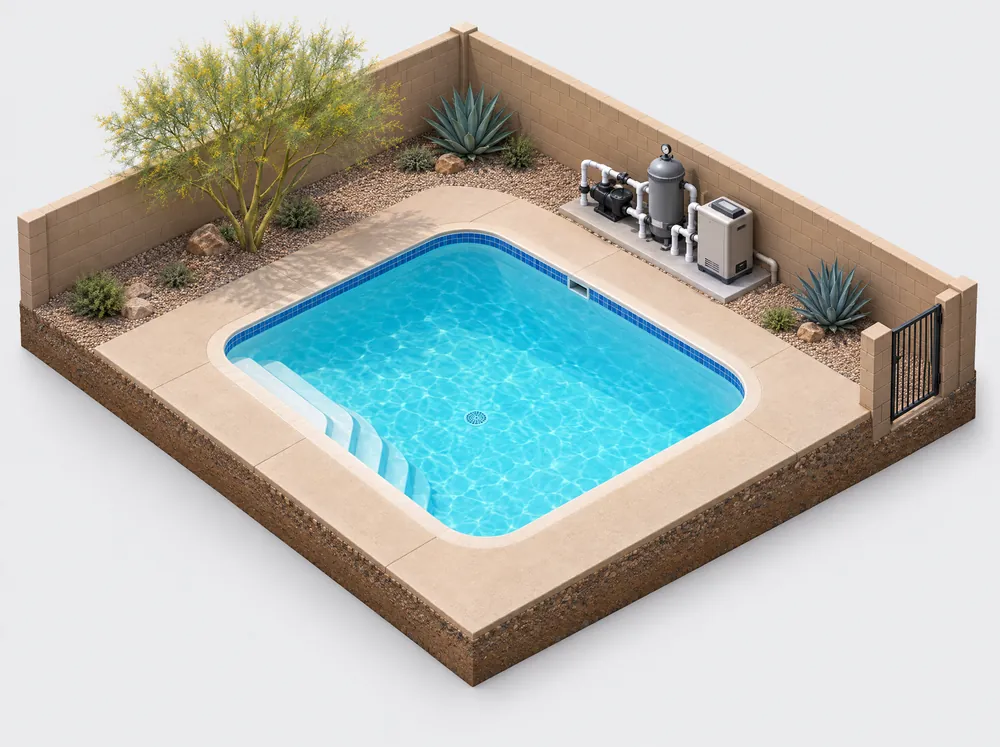
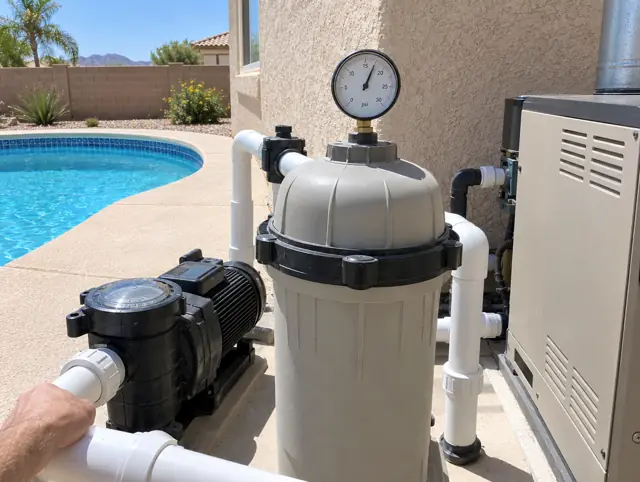
Pump running and primed, no drips at the pad, filter pressure noted. Heater and salt cell checked too.
-
Leaves, bugs and the dust a monsoon storm drops, netted off before they sink and stain.
![A leaf net skimming leaves and palo verde blossoms off the water]()
-
A clogged skimmer is the first thing that slows the water down.
![Hands lifting a skimmer basket full of leaves out of the skimmer]()
-
Brushing breaks up the film algae starts as, before you can see it. The waterline tile gets its own pass.
![A brush on a pole scrubbing the blue waterline tile]()
-
As needed. We also make sure your pool cleaner is running and not stuck in a corner.
![A vacuum head on a pole cleaning the pool floor]()
-
A full basket starves the pump and shortens its life.
![Hands opening a pool pump lid to a strainer basket full of leaves]()
-
Chlorine, pH and alkalinity every visit. We add only what the readings call for, and record what went in.
![Hands holding a water test kit showing chlorine and pH readings]()
-
Lids on, gate latched. Then you get the service report: what was done, the readings and photos.
![A hand latching the pool gate closed at the end of a visit]()


What we test for
We test chlorine, pH and alkalinity every visit. Calcium, stabilizer and salt we check on a schedule, or sooner if something looks off.
| Reading | We aim for | Why it matters |
|---|---|---|
| Free chlorine | 2–4 ppm | Keeps the water sanitized. Summer sun burns it off fast, so it’s the reading we watch most. |
| pH | 7.4–7.6 | Comfortable on skin and eyes, lets chlorine work, and keeps scale off the tile. |
| Total alkalinity | 80–120 ppm | Holds the pH steady between visits. |
| Calcium hardness | 200–400 ppm | Valley tap water is hard. Too much calcium shows up as white scale at the waterline. |
| Stabilizer (CYA) | 30–80 ppm | Shields chlorine from the sun. Chlorine tabs add more every week, and when it climbs too high the fix is a partial drain. |
| Salt | 2,700–3,400 ppm | Salt pools only: the level your salt cell needs to make chlorine. Your cell’s label has its exact range. |
A Phoenix pool maintenance schedule, season by season
Phoenix pools go through a lot in a year. Here’s what changes each season, and what we do about it.
Spring
March to May
Highs from the upper 70s to the mid 90s
The water warms up and algae starts to grow. We clean the filter before summer, turn the pump’s run time up and shut the heater off for the year.
Summer
June to September
Highs over 100°F
Chlorine burns off fastest now, so we test and adjust every visit. In June and July a pool can lose about half an inch of water a day to evaporation. Monsoon season runs June 15 to September 30, and the storms leave dust and debris behind, so expect extra brushing and a filter clean when it’s over.
Fall
October to November
Highs near 90°F in October, cooling into November
Chlorine demand drops and the leaves start to fall. Heater season begins, and it’s time for the second filter clean of the year.
Winter
December to February
Highs in the mid 60s
Pumps run shorter hours, and freeze protection matters on the odd cold night. With highs well under 90°F, this is the time to drain the pool, do a chemical wash or take on bigger repairs. The water goes down the home’s sewer clean-out, which is what the City of Phoenix asks for.
We write everything down
Every visit gets logged: the readings, what we added, photos, and anything we noticed. So if your heater acts up in December, we can see what it’s been doing since June.
You can see all of it in your customer portal, along with your bills.
- Readings
- Chlorine, pH, alkalinity and the rest, with the date
- Chemicals added
- What went in, and how much
- Photos
- The water and anything worth showing you
- Notes
- A slow leak, a noisy motor, a lid that won’t sit right
Pool questions we get in Phoenix
How much water does a pool lose a day in Phoenix?
In June and July, about half an inch a day to evaporation, and more on hot, windy days. In winter it’s a small fraction of that. If your pool drops much faster, it may be a leak, and we can check.
When is the best time to drain a pool in Phoenix?
In the cooler months, roughly November through March. Draining when it’s 90°F or hotter lets the exposed plaster dry out and crack in the sun.
How often should a pool filter be cleaned in Phoenix?
Usually two or three times a year: before summer, after monsoon season, and any time the pressure gauge reads about 8 to 10 psi above its clean reading.